

BOX 005 | 4 MIN READ | METRICS
Every important KPI needs a second number that tells you what might be getting worse.
Tell a sales team to increase conversion and conversion will probably go up.
Tell a service team to reduce response times and responses will probably get faster.
Tell an operations team to increase output and output will probably increase.
That is the point of a metric.
But something else can move at the same time.
Discounting rises. Quality drops. Customers have to contact you again. Errors increase.
The metric improved. The business didn’t.
Metrics are instructions
The moment you attach a target to a number, you are not just measuring performance.
You are telling people what to optimise.
And most business outcomes have a trade-off somewhere.
Growth can hurt margin.
Speed can hurt quality.
Efficiency can hurt customer experience.
The problem is not the KPI.
It is the KPI on its own.
A useful way to fix that is to pair it with the thing you need to protect.
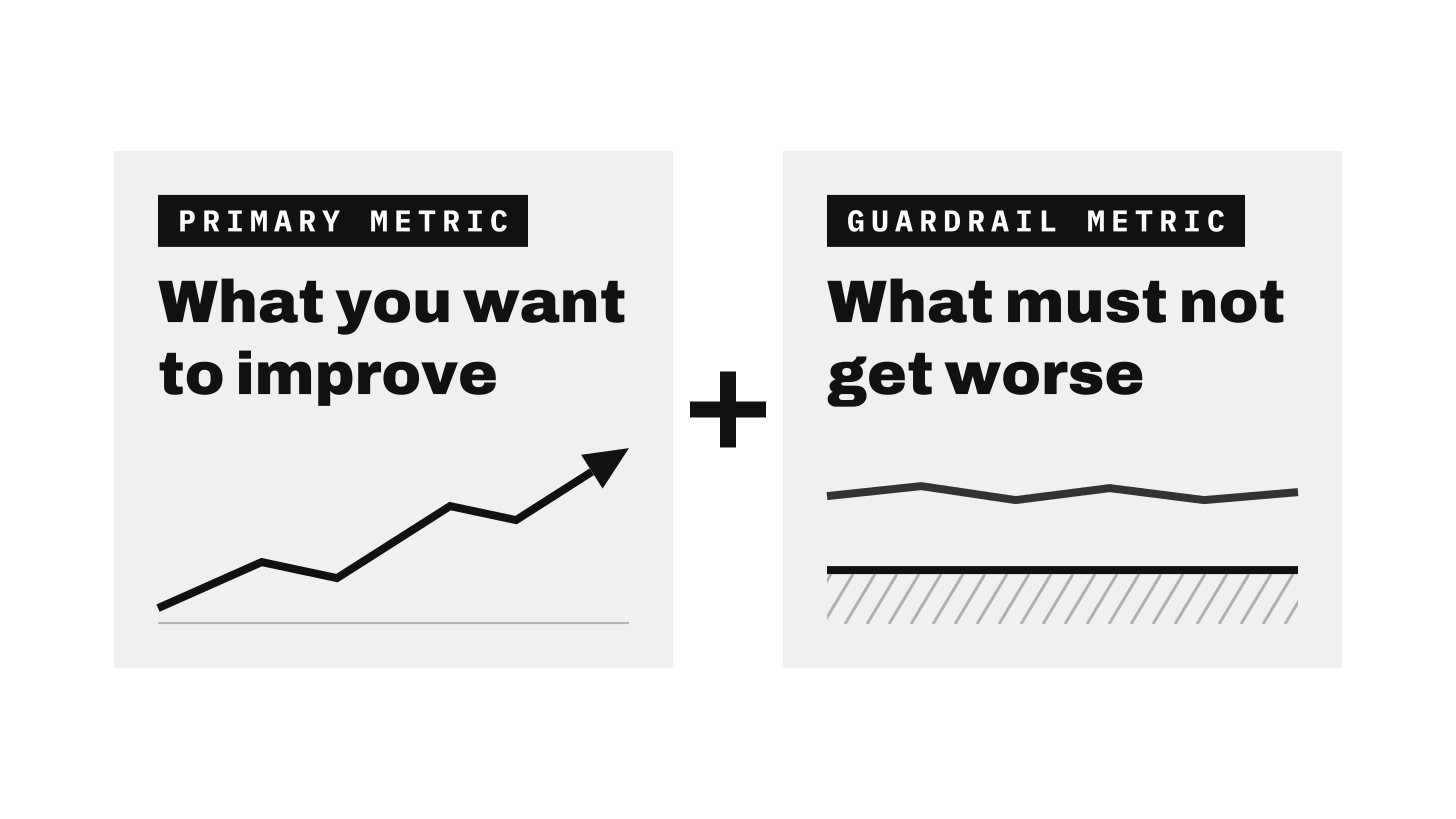
Primary metric + guardrail metric
The primary metric tells you what you want to improve.
The guardrail tells you whether you are improving it in the wrong way.
For example:
Sales growth + contribution margin
Conversion + cancellation rate
Response time + repeat contact
Orders processed + error rate
Customer acquisition + retention
Time to hire + 90-day retention
Deployment frequency + production incidents
Take customer service.
Imagine the team reduces average response time from six hours to one.
Looks good.
But if repeat contacts double because agents are replying quickly rather than actually solving the problem, you have not really improved the service.
You have improved the metric.
The repeat-contact number exposes the difference.
That is what a good guardrail does.
Find the failure mode
You do not need a clever measurement framework.
For every important target, ask three questions:
What behaviour will this encourage?
If people get very good at improving it, what could get worse?
What number would tell us that was happening?
That third answer is usually your guardrail.
If you measure speed, what protects quality?
If you measure cost, what protects service?
If you measure growth, what protects margin?
The idea is not to stop people optimising.
You want them to optimise.
You just want the target to describe the outcome you actually care about.
Don’t create metric soup
There is an obvious way to ruin this.
Give every KPI five counter-metrics.
Now nobody knows what matters.
This is not an argument for bigger dashboards.
You do not need to pair every number you report.
Pair the metrics people are actively being asked to improve.
And the guardrail does not always need a target of its own.
Sometimes it is simply a boundary.
Grow revenue, provided contribution margin stays above X.
Reduce response time, provided repeat contact stays below Y.
Increase throughput, provided errors do not rise.
That is often enough.
Run the pairing test
Take the handful of metrics that get the most attention in your business.
The ones discussed every week.
The ones on the board pack.
The ones tied to bonuses.
For each one, ask:
How could somebody make this number look brilliant while making the business worse?
If there is an obvious answer, your KPI probably needs a partner.
The bottom line
Metrics shape behaviour.
So whenever you ask someone to improve a number, ask one more question:
What must not get worse?
Put that number beside it.
Until the next BOX,
COO in a Box
One operating idea. Put it to work.