

BOX 006 | 4 MIN READ | SYSTEMS
Things are taking too long.
Spreadsheets are multiplying. People are chasing updates. Approvals are slowing everything down. Teams have developed their own workarounds.
So somebody suggests a new platform.
It promises workflows, reminders, dashboards and maybe a little AI.
The demo looks brilliant.
The problem is that nobody has stopped to ask whether the underlying process makes any sense.
A bad process doesn’t become a good process because you’ve automated it. It just becomes a bad process that happens faster.
Technology is the tempting answer
When a business starts to grow, things that used to work begin to break.
There’s a useful rule of thumb called the Rule of 3 and 10. What works for 10 people often stops working at 30. What works at 30 needs rethinking by 100.
The informal approval process becomes a bottleneck. The knowledge that lived in somebody’s head becomes a problem when they go on holiday.
These are real growing pains.
And technology can absolutely help.
But buying software is often more attractive than doing the less exciting work of understanding why things have become difficult.
A new platform promises a solution.
Redesigning a process means asking uncomfortable questions about why people do things the way they do.
Guess which one gets more enthusiasm.
You’re often automating yesterday’s decisions
Most business processes weren’t deliberately designed.
They evolved.
Someone introduced an approval after a mistake. Another person created a spreadsheet because the existing system didn’t show something they needed. A third team added a check because they didn’t trust the information coming from the first two.
Each change probably made sense at the time.
Two years later, nobody remembers why half the steps exist.
But everybody follows them.
Then the business decides to automate the process.
The requirements document carefully describes every existing step, approval and exception. The technology team builds exactly what’s been requested.
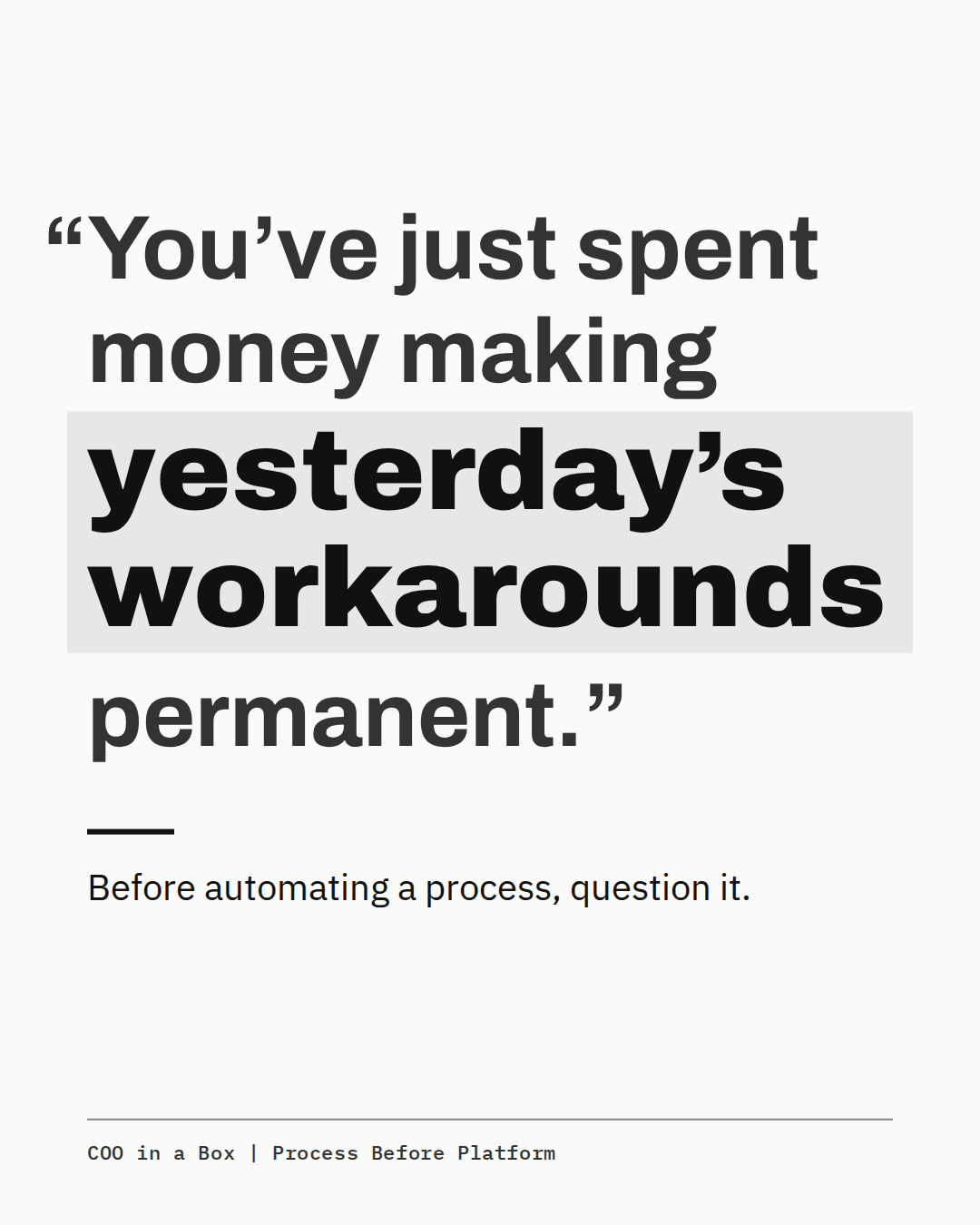
You’ve just spent money making yesterday’s workarounds permanent.
The opportunity wasn’t simply to automate the process.
It was to question it.
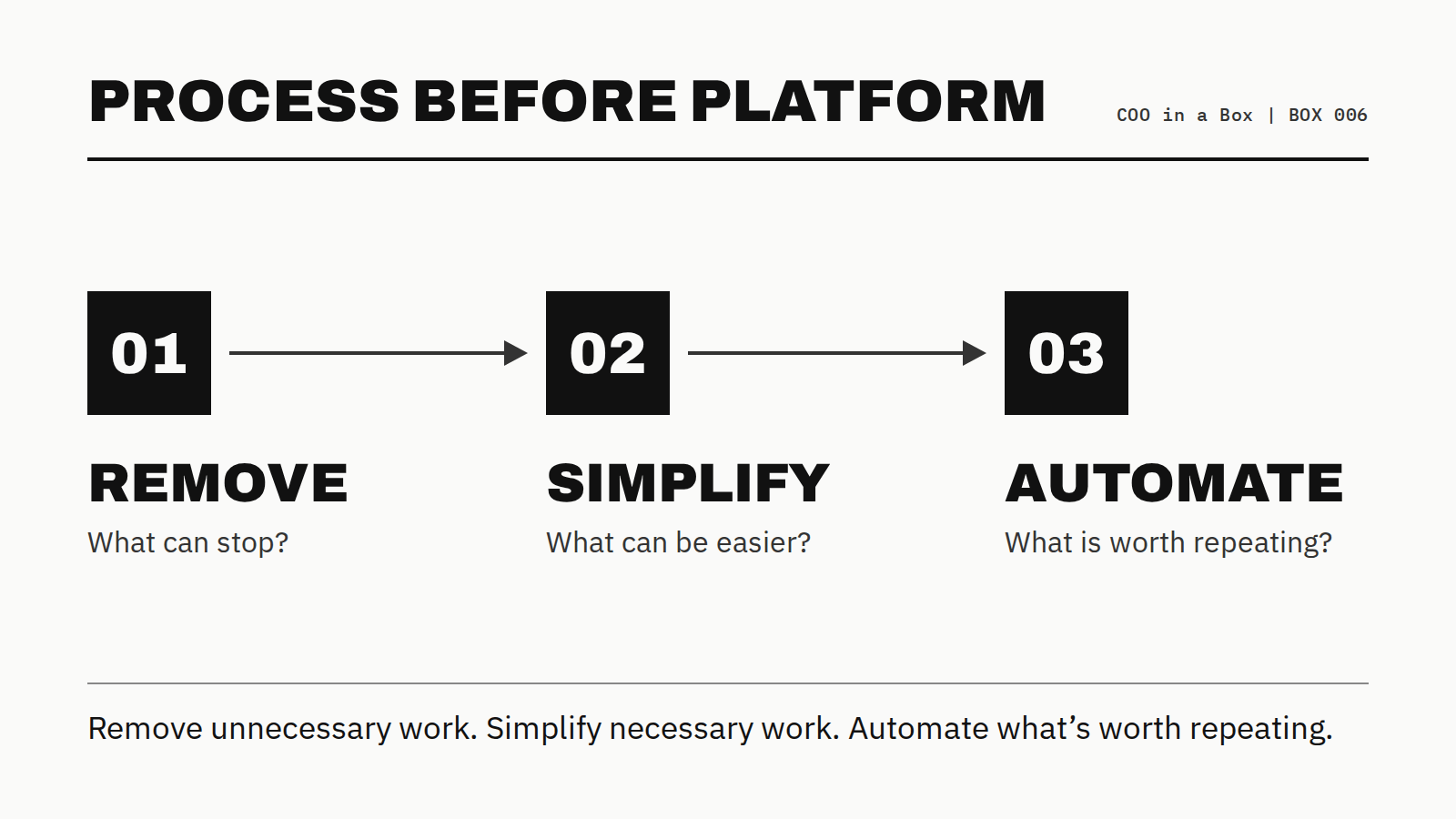
Remove. Simplify. Automate.
Before introducing technology, put the process through three tests.
1. Remove it
Start with the most uncomfortable question.
What would actually happen if we stopped doing this?
Not every step creates value.
Some exist because of an old policy. Some duplicate work happening elsewhere. Others solve problems that no longer exist.
Ask:
Does this step produce something somebody genuinely needs?
Is it required for a clear commercial, customer or risk reason?
Would anyone notice if we stopped doing it?
If a step doesn’t serve a useful purpose, removing it is better than automating it.
2. Simplify it
For everything that needs to remain, ask whether there’s an easier way.
Can information be captured once instead of three times?
Can one person own an outcome instead of passing it between departments?
Can routine decisions happen without unnecessary approvals?
Can ten variations of the same process become one standard approach, with exceptions handled separately?
This is where a surprising amount of improvement happens.
Often without buying anything.
3. Automate it
Now look at what remains.
If the process is clear, repeatable and necessary, technology can make a genuine difference.
Automate the predictable work. Make information available where it’s needed. Remove repetitive administration and unnecessary waiting.
Keep human judgement where it adds value.
The order matters.
Remove unnecessary work.
Simplify necessary work.
Then automate what’s worth repeating.
Don’t turn this into an excuse to avoid technology
There is an important distinction.
Sometimes the technology really is the problem.
A manual process might be perfectly sensible, but impossible to operate reliably at scale. A legacy system might prevent information from moving between teams. A business might need capabilities it simply doesn’t have.
In those cases, new technology may be exactly the right investment.
The point isn’t to resist software or AI.
It’s to understand the job you’re asking it to do.
You should be able to explain the outcome you want, the work that genuinely needs to happen and the problem technology will solve.
If you can’t explain those things, you’re probably not ready to write the requirements.
Run the process-before-platform test
Pick one process your business is considering automating or replacing with new software.
Take the last five times that process was used and follow what actually happened, not what the procedure says should happen.
Then ask:
Remove: Which steps could disappear without damaging the outcome?
Simplify: Where are we creating unnecessary handoffs, duplication or approvals?
Automate: Which remaining activities are frequent, predictable and worth automating?
You don’t need a six-month transformation programme.
Start with one process.
You might discover that you don’t need the software at all.
Or you might find that a much simpler process makes the software dramatically more valuable.
Either way, you’ve improved the investment decision.
The bottom line
Technology is a powerful way to scale the way your business works.
That’s precisely why you should be careful about what you ask it to scale.
Before buying another platform or building another automation, ask:
If we were starting from scratch today, would we design the process this way?
If the answer is no, fix that first.
Until the next BOX,
COO in a Box
One operating idea. Put it to work.