

BOX 008 | 4 MIN READ | GROWTH
In the early days, speed comes from simplicity.
A small team. Short conversations. Quick decisions. Everyone knows what’s happening, and when something needs doing, somebody picks it up.
You don’t need much structure because everyone is close enough to the work to keep things moving.
And it works.
The business grows. You hire good people. Customers keep coming. Revenue increases.
Then, gradually, things start getting harder.
Decisions take longer. People aren’t quite sure who owns what. Information gets lost. Teams start pulling in different directions.
The instinct is to fix what’s going wrong.
But often, nothing has gone wrong.
The business has simply outgrown the way it works.
Success has a shelf life
Every growing business develops habits that help it succeed.
Some become part of its identity.
“We’re entrepreneurial.”
“We don’t need lots of process.”
“Everyone just gets stuck in.”
“We’ve always been good at moving quickly.”
These are often genuine strengths. They’re part of what made the business successful in the first place.
But strengths are contextual.
A way of working that creates speed with eight people can create confusion with eighty.
Being flexible can become a lack of accountability.
Keeping everyone involved can become too many people involved in every decision.
Doing things informally can become a dependence on conversations that half the business never hears.
The behaviour hasn’t necessarily changed.
The environment around it has.
And that’s what makes this difficult to recognise.
The trap of protecting what worked
When businesses encounter growing pains, they often try to preserve the very things that are causing them.
A founder notices the business has become slower and insists on keeping things informal.
A team struggles with inconsistent decisions but resists introducing clearer responsibilities because it doesn’t want to become bureaucratic.
People complain about communication, so the business adds more meetings to recreate the closeness it once had naturally.
The intention is understandable.
Nobody wants to lose what made the business special.
But preserving the past isn’t always the same as protecting what matters.
Perhaps what made the company successful wasn’t informality itself. It was the ability to make decisions quickly.
Perhaps it wasn’t everyone doing everything. It was a willingness to help each other.
Perhaps it wasn’t the absence of structure. It was the absence of unnecessary complexity.
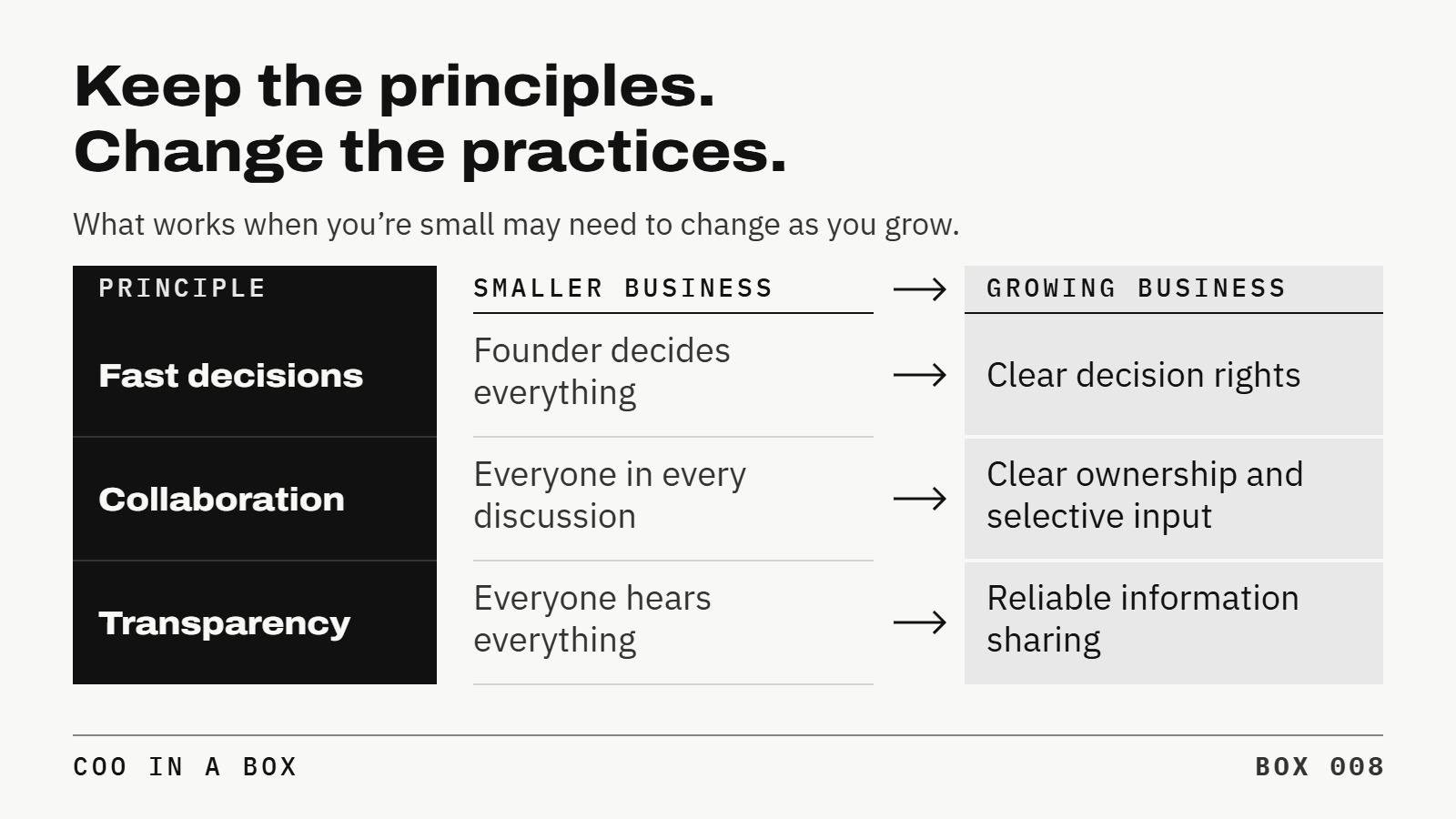
The principle is worth keeping. The way you deliver it may need to change.
That distinction matters.
You don’t have to abandon what made your business good.
You have to find a new way of achieving it.
Growth requires subtraction as well as addition
Most businesses approach growth by adding things.
More people. More meetings. More processes. More management. More software.
Some of those additions are necessary.
But growth also requires removing ways of working that no longer fit.
The weekly all-hands discussion that worked with twelve people may no longer be useful with sixty.
The informal approval process that once took five minutes may now hold up entire teams.
The expectation that everyone knows what’s happening may no longer be realistic.
These practices aren’t necessarily bad.
They’ve simply reached the end of their useful life.
The mistake is treating them as permanent features of the business rather than temporary solutions to a particular stage of growth.
The Expiry Date Test
Take 20 minutes with your leadership team.
Look at how the business operates today and ask three questions:
1. What worked brilliantly when we were smaller?
Think about how decisions were made, how teams communicated, how work was allocated and how problems were resolved.
2. Which of those things are now creating friction?
Look for repeated confusion, delays, unnecessary dependencies or activities that require increasing effort to produce the same result.
3. What principle were we trying to protect, and how would we deliver it today?
Don’t automatically throw away the old approach. Identify what made it valuable, then design a version that works for the business you’ve become.
For example:
• Keep fast decisions, but give teams clear authority to make them.
• Keep collaboration, but make ownership explicit.
• Keep transparency, but replace informal updates with reliable ways to share information.
Pick one practice that has outlived its usefulness and redesign it.
Not the whole business. Just one thing.
The bottom line
The business that got you here did its job.
It helped you find customers, build momentum and reach the next stage.
But there’s no reason to assume the same ways of working will get you where you want to go next.
The challenge isn’t to preserve everything that made you successful.
It’s to understand why those things worked, and be willing to change how they work.
Keep the principles. Change the practices.
That’s how you grow without losing what made the business worth building.
COO in a Box | Simple instructions for a better business.
One practical operating idea each week to help you run a better business, without hiring a COO.