

BOX 001 · 5 MIN READ
Growing businesses have a habit of fixing problems where they appear.
A customer waits too long, so we add another person to customer service. A project slips, so we add another status meeting. A team keeps making mistakes, so we add another check. Someone can’t make a decision, so the founder gets pulled back in.
Sometimes that works.
Quite often, though, we’ve just added more process around the real problem.
Because the place where friction appears isn’t necessarily the place where it starts.
The problem you can see isn’t always the problem you have
Imagine customers are waiting three days for answers to fairly simple questions.
The obvious conclusion is that customer service is too slow.
So you improve the acknowledgement email. Set a tighter response target. Maybe add another person to the team.
All perfectly reasonable.
But none of that tells you why the answer takes three days.
Look a little deeper and you might find something else going on.
The customer team receives the question but can’t answer it themselves. They send it to Marketing. Marketing sends it to Sales. Sales needs something from Finance. Eventually, somebody asks the founder.
Three days later, the customer gets their answer.
The customer sees slow service.
Inside the business, the work is bouncing between teams.
Underneath that, nobody clearly owns the decision.
That is the Friction Map.
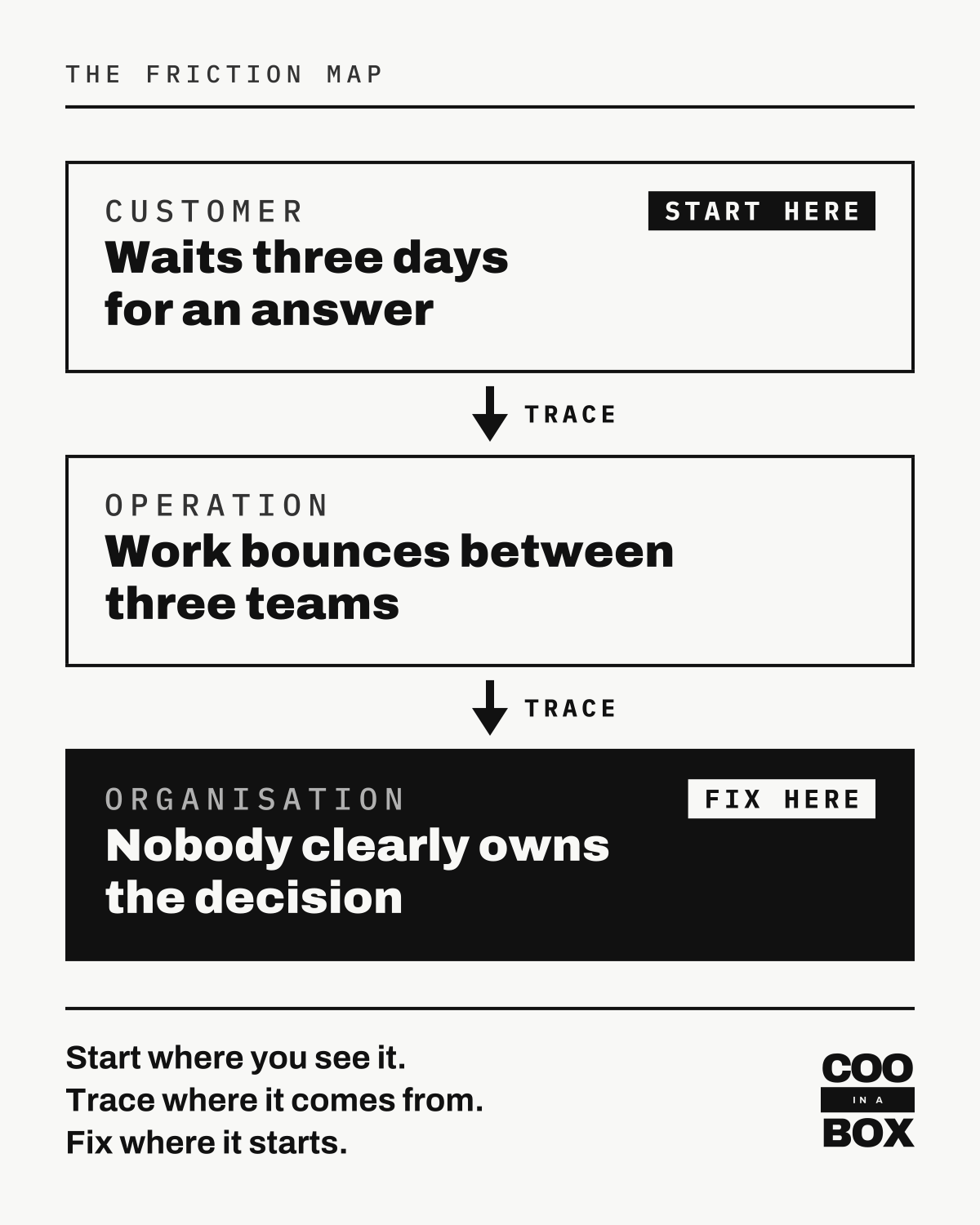
The visible problem is often the end of the chain, not the beginning.
Three places friction hides
Most recurring friction sits in one of three places.
01 - CUSTOMER FRICTION
This is what the customer feels.
Waiting too long. Not knowing what happens next. Having to chase. Repeating information they’ve already given you. Finding something harder to buy, use or get help with than it needs to be.
Customer friction is usually the easiest to spot because customers tell you about it.
But it isn’t always where the problem starts.
02 - OPERATIONAL FRICTION
This is how the work behaves inside the business.
Work sits in queues. It changes hands unnecessarily. The same information gets entered twice. People create workarounds because the normal process doesn’t quite work. Things need checking, correcting or chasing.
This is often where the customer problem is actually being created.
03 - ORGANISATIONAL FRICTION
This is why the work behaves that way.
Nobody clearly owns the outcome. Two teams are working to different priorities. People need permission for decisions they should be able to make themselves. Important knowledge sits in one person’s head.
This is where a surprising amount of everyday friction begins.
The three categories are useful to understand but the more important thing is the relationship between them. Friction travels downstream. Diagnosis should travel upstream.
Start with a different question
When something keeps going wrong, the natural reaction is: How do we fix this?
Before answering that, ask: Where does this actually start?
That small shift changes how you look at the problem. If you fix friction too far downstream, you can end up making the symptom easier to live with without removing the cause.
A better customer email might make a three-day wait feel more professional. It still doesn’t make the answer arrive any faster.
A new workflow might move a request neatly between five people. It still doesn’t explain why five people need to be involved.
I’ve seen businesses build surprisingly sophisticated processes around problems that could have been stopped somewhere else.
YOU WILL NEED
One recurring annoyance in your business
15 minutes
Ideally, someone who actually does the work
Don’t try to map the whole company.
Pick one thing that keeps happening and annoys you every time it does.
STEP 01 - Start with the symptom
Write down what is actually happening, without jumping straight to the solution.
Maybe:
Customers keep chasing us.
Quotes take too long.
Projects get stuck before launch.
Refunds always need senior approval.
People keep asking me the same question.
Be specific.
“Communication needs improving” tells you almost nothing.
“Every project needs three messages before anyone knows whether it has been approved” gives you something you can actually investigate.
STEP 02 - Trace it upstream
Now follow the problem backwards through the three layers.
Start with the customer or visible symptom.
Where is someone waiting, guessing, chasing, repeating themselves or doing work they shouldn’t need to do?
Then look at the operation.
What is happening inside the business to create that experience? Where is work waiting, changing hands, being entered twice, corrected or worked around?
Then look underneath that.
Who owns the outcome? Who is allowed to make the decision? Are two teams working to different priorities? Does someone need permission they shouldn’t need? Does critical knowledge live with one person?
Keep tracing until you reach something that, if changed, would remove some of the friction further down the chain.
That’s usually where things get interesting.
STEP 03 - Fix the highest useful cause
You don’t automatically need to fix all three layers.
And you don’t need to keep digging just because you can.
Sometimes confusing checkout copy is simply confusing checkout copy. Fix it.
Sometimes somebody is manually copying information between two systems. Fix the workflow.
Sometimes six people are involved because nobody is quite sure who is allowed to say yes.
That’s usually the point where I’d stop mapping.
The aim is to find the highest useful cause: the earliest sensible point in the chain where one change removes friction below it.
COMMON MISTAKE
Mapping the whole business.
Resist the temptation.
This does not need to turn into a transformation programme, a wall covered in Post-it notes or three weeks spent documenting every process in the company.
Take one recurring problem.
Trace it. Fix it. Then take another.
CHECK
Ask:
If we fix this cause, should the friction below it disappear without creating more effort somewhere else?
If the answer is yes, you’ve probably found the right place to intervene.
If not, keep tracing.
DONE
You should eventually be able to describe the problem in one short chain:
Customers wait for answers
because work keeps changing hands
because nobody clearly owns the decision.
Once you can see the chain, deciding what to fix becomes much easier.
Growing businesses naturally accumulate friction.
More people create more handoffs. More products create more exceptions. More teams create more dependencies.
You won’t remove all of it.
But you can stop building solutions around symptoms.
Next time something keeps going wrong, don’t ask where the problem is visible. Ask where the friction starts.
COO in a Box
Run a better business. One operating idea at a time.
Written anonymously by an experienced COO, co-founder and operator.