

BOX 007 | 4 MIN READ | EXECUTION
A customer asks for something.
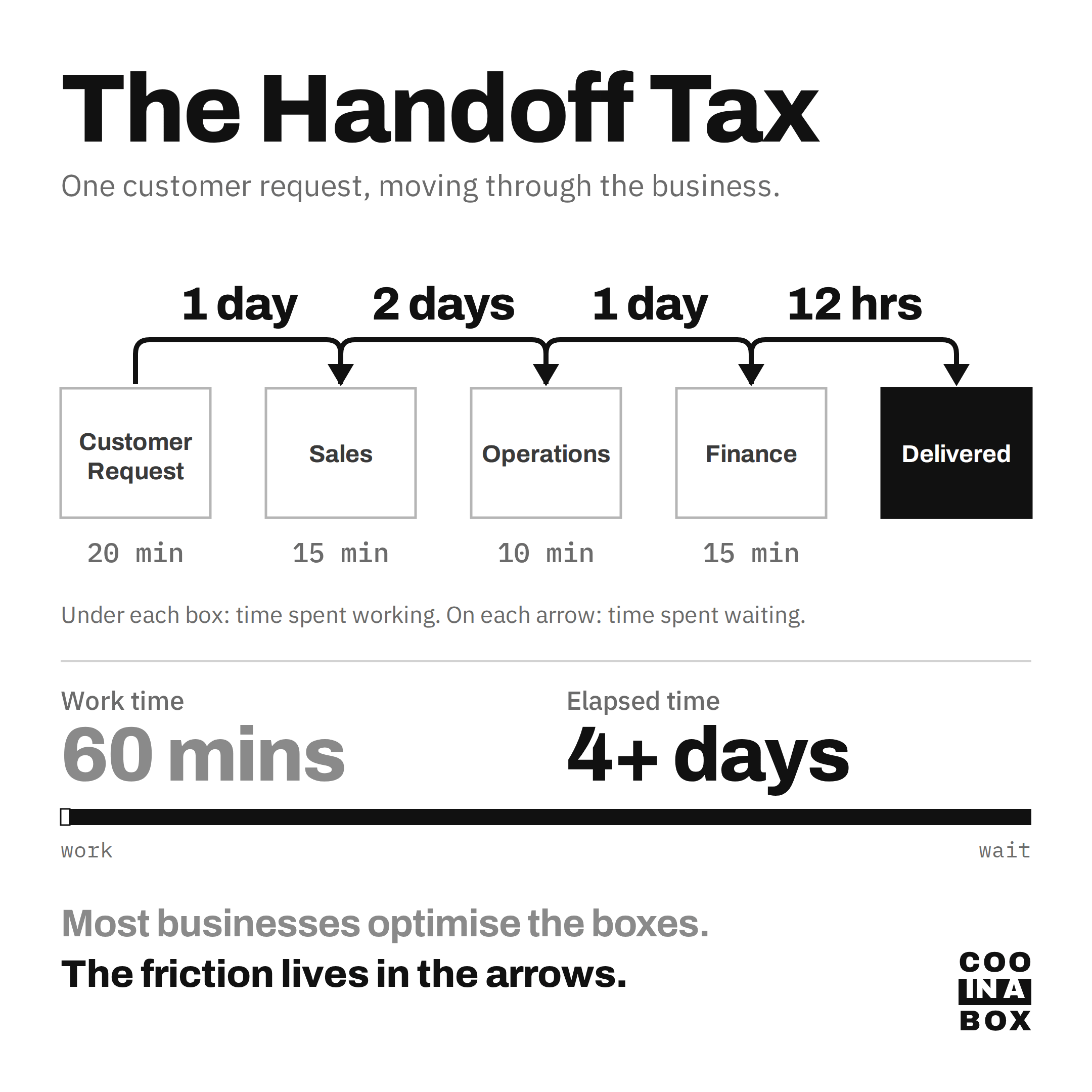
Sales collects the details and passes them to Operations.
Operations discovers something is missing and goes back to Sales.
Sales contacts the customer.
The answer comes back, but the person handling the request has moved on to something else.
Eventually, everything is ready.
The actual work takes 20 minutes.
The customer has been waiting four days.
Nobody has been particularly slow. Everyone has been busy. Each team might even be meeting its own performance targets.
Individually, everyone is doing their job. Collectively, the business is failing to deliver.
Every handoff has a cost
Most businesses organise themselves into teams, functions and responsibilities.
Sales sells. Operations delivers. Finance invoices. Customer Service handles problems.
That makes sense.
But customers and business outcomes don’t follow organisational charts. They move across them.
Every time work moves between people or teams, information, context and responsibility need to move with it.
When they don’t, you pay the Handoff Tax.
It shows up in four ways:
(1) Waiting: Work sits in a queue until somebody picks it up.
(2) Missing context: The receiving person doesn’t have everything needed to continue.
(3) Rework: Information gets checked, clarified or collected again.
(4) Ownership gaps: Everyone assumes somebody else is responsible for moving things forward.
A process with six handoffs creates six opportunities for something to go wrong.
And even when nothing goes wrong, each transfer introduces the possibility of another delay.
We optimise the boxes and ignore the arrows
When performance needs improving, businesses usually look inside individual teams.
Can Sales process enquiries faster?
Can Operations complete more jobs?
Can Finance issue invoices sooner?
But improving the performance of individual teams doesn’t necessarily improve the performance of the whole business.
Imagine a process involving three teams.
Each team takes one hour to complete its work.
That’s three hours of actual activity.
But there are two days of waiting between each stage.
The customer waits more than four days.
You could double the productivity of every team and save just 90 minutes.
The customer would barely notice.
Most businesses optimise the boxes. The friction lives in the arrows.
The more useful question isn’t always how quickly each team works.
It’s how efficiently the whole process delivers the outcome.
The Handoff Map
You don’t need a complicated process improvement programme to find these problems.
Choose one important workflow that crosses multiple people or teams.
For example, turning a signed customer agreement into a live service.
Map the journey from beginning to end.
At every point where work changes hands, answer four questions:
1. Who has it? Who is responsible for the work at this stage?
2. Who gets it next? Name the person or role receiving the work. Not just the department.
3. What must travel with it? What information, decisions, documents or approvals does the next person need to act without going backwards?
4. Who now owns it? When does responsibility transfer, and how does everyone know?
Then measure two things:
(A) Work time: How long does somebody actually spend completing the task?
(B) Wait time: How long does it sit before the next person starts?
The difference can be revealing.
You might discover that a task taking an hour to complete spends three days waiting to be picked up.
Or that incomplete information repeatedly sends work backwards.
Or that a request disappears because ownership was never properly transferred.
Now you can see where the process is actually losing time.
Remove the tax
Once you’ve identified the expensive handoffs, there are three ways to improve them.
1. Remove unnecessary handoffs.
Does the work genuinely need to move between these people? Could one person own more of the journey?
2. Make necessary handoffs complete.
Define what must be provided before work transfers. A clear definition of ‘ready’ prevents incomplete requests bouncing backwards.
3. Make ownership unmistakable.
A handoff isn’t complete because somebody sent an email or updated a status.
It’s complete when the next person has what they need and has accepted responsibility for what happens next.
The goal isn’t to eliminate every handoff. Specialisation and collaboration are necessary.
It’s to stop paying for transfers that add no value.
Try this on Monday
Pick one workflow where customers, employees or suppliers regularly complain about delays.
Trace one real piece of work from beginning to end.
Measure the time spent doing the work against the time spent waiting.
Find the handoff creating the biggest delay, then ask:
Can we remove it, improve what gets passed across, or make ownership clearer?
Fix that handoff first.
You might not need more people, a new system or another performance target.
You might just need to redesign the space between two people’s jobs.
Until the next BOX,
COO in a Box
One operating idea. Put it to work.