

BOX 004 | 4 MIN READ | RHYTHM
Most businesses have a strange relationship with meetings.
A £10,000 contract gets questioned, approved and reviewed.
But putting eight people in a room for an hour every week can happen almost accidentally.
Someone creates the meeting.
It becomes recurring.
And six months later, everyone is still attending because it is already in the diary.
Calendar time rarely feels like spending. But it is.
A meeting has a price
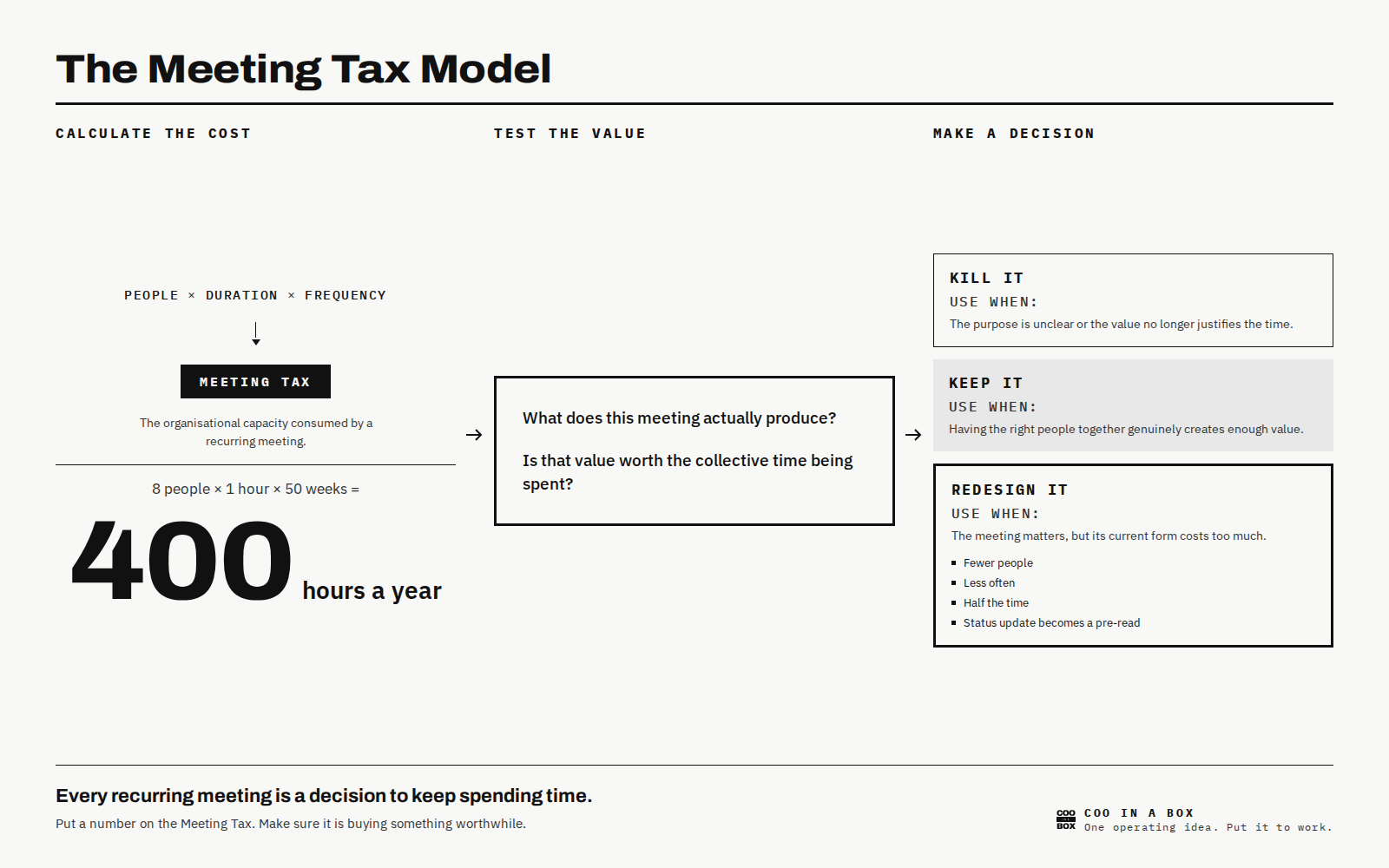
Take a weekly one-hour meeting with eight people.
That is not a one-hour meeting.
It is eight hours of organisational capacity every week.
Run it for 50 weeks and you have spent 400 hours.
And that is before you count preparation, follow-up or the interruption created either side of it.
A simple way to expose this is:
Meeting Tax = people × duration × frequency
You do not need to turn every meeting into a financial model.
Person-hours are usually enough.
Once you see the number, a meeting that felt harmless can suddenly look quite expensive.
The problem is recurrence
Some meetings are enormously valuable.
A good 30-minute conversation can resolve something that would otherwise take three days of emails, messages and confused hand-offs.
The problem is not meetings.
The problem is that recurring meetings become permanent without repeatedly having to justify their existence.
The original problem get solved.
The team changes.
The work changes.
But the meeting survives.
What began as a temporary coordination mechanism to solve a problem or explore an opportunity quietly becomes part of everyone’s week.
Make every recurring meeting earn its place
Once a quarter, take the recurring meetings across the business and put each one through three choices:
1. Kill it
Remove meetings where:
the main purpose is giving people information
nobody can clearly explain what would break if the meeting disappeared
attendance is mostly habit or attendees regularly skip it
the same conversation could happen when there is actually something to discuss
Information does not necessarily need everyone to consume it at the same time.
Sometimes a short written update is better than a meeting.
2. Keep it
Keep meetings where having people together genuinely creates value.
The important question is not: “Is this meeting useful?”
Almost every recurring meeting can produce some useful conversation.
Ask instead:
Is the value created worth the collective time we are spending?
That is a much, but more valuable harder test.
3. Redesign it
Often the meeting should exist, but the current version should not.
Try changing one variable:
eight people becomes four
weekly becomes fortnightly
60 minutes becomes 30
five agenda items become the two that actually require discussion
the status update becomes a pre-read
optional attendees stop being permanent attendees
You can often remove half the meeting tax without removing the meeting.
The smallest changes compound
Imagine five managers each attend four unnecessary hours of recurring meetings a week.
That is 20 hours of management capacity.
Every week.
Roughly 1,000 hours across a year.
No recruitment programme would casually add that much work to five people’s jobs.
But calendars do it quietly.
And the cost is not just the time inside the meeting.
Those hours are usually taken from the work that is easiest to postpone:
Making a difficult decision before it becomes an urgent one.
Coaching someone who is capable of more but needs your attention.
Fixing the process that keeps creating the same problem.
Talking to the customer who is quietly becoming frustrated.
Writing the strategy everyone keeps saying they need.
Improving how the business works.
This is why overloaded calendars can create a strange loop.
People spend so much time coordinating the work that they have less time to improve the work, which creates more problems that require more coordination.
Do the audit
Open the calendar for a typical week.
Ignore one-off meetings.
Look only at the recurring ones.
For each meeting, write down:
People × minutes × frequency
Then ask:
What is this meeting actually for?
What would happen if we stopped it for a month?
Does everyone need to be there?
Does it need to happen this often?
Does the information need to be delivered live?
Could we achieve the same outcome in half the time?
Then make a decision:
Kill. Keep. Redesign.
Do not try to create the perfect calendar.
Just remove the meetings whose cost is no longer justified by what they produce.
The bottom line
Meetings are not free because everyone’s salary is already being paid.
Time is the resource the business cannot replenish.
Every recurring meeting is a decision to keep spending some of it.
Put a number on the Meeting Tax, and make sure it is buying something worthwhile.
Until the next BOX,
COO in a Box
One operating idea. Put it to work.