

BOX 003 · 4 MIN READ · PRIORITIES
Most businesses don’t suffer from a shortage of priorities.
They suffer from having so many that the word has stopped meaning anything.
Sales has seven. Operations has nine. Finance has six. The leadership team has twelve things marked “critical”.
Then someone adds another.
Nothing gets removed.
And everyone carries on.
The problem isn’t that the business has too much work.
The problem is that we’ve confused everything that needs doing with everything that needs changing.
The Rule of Three isn’t the workload
Take Finance.
It still needs to:
run payroll
pay suppliers
produce management accounts
manage tax and compliance
maintain controls
support the rest of the business
None of that disappears because Finance has three priorities.
Those are KEEP RUNNING activities.
The priorities are the small number of things Finance is deliberately trying to improve, fix or change right now.
For example:
KEEP RUNNING
Payroll. Accounts. Cash collection. Reporting. Compliance.
MOVE FORWARD
Reduce debtor days from 48 to 35.
Cut month-end close from ten days to five.
Introduce weekly cash forecasting.
That’s the distinction.
The Rule of Three isn’t the workload. It’s the change agenda.
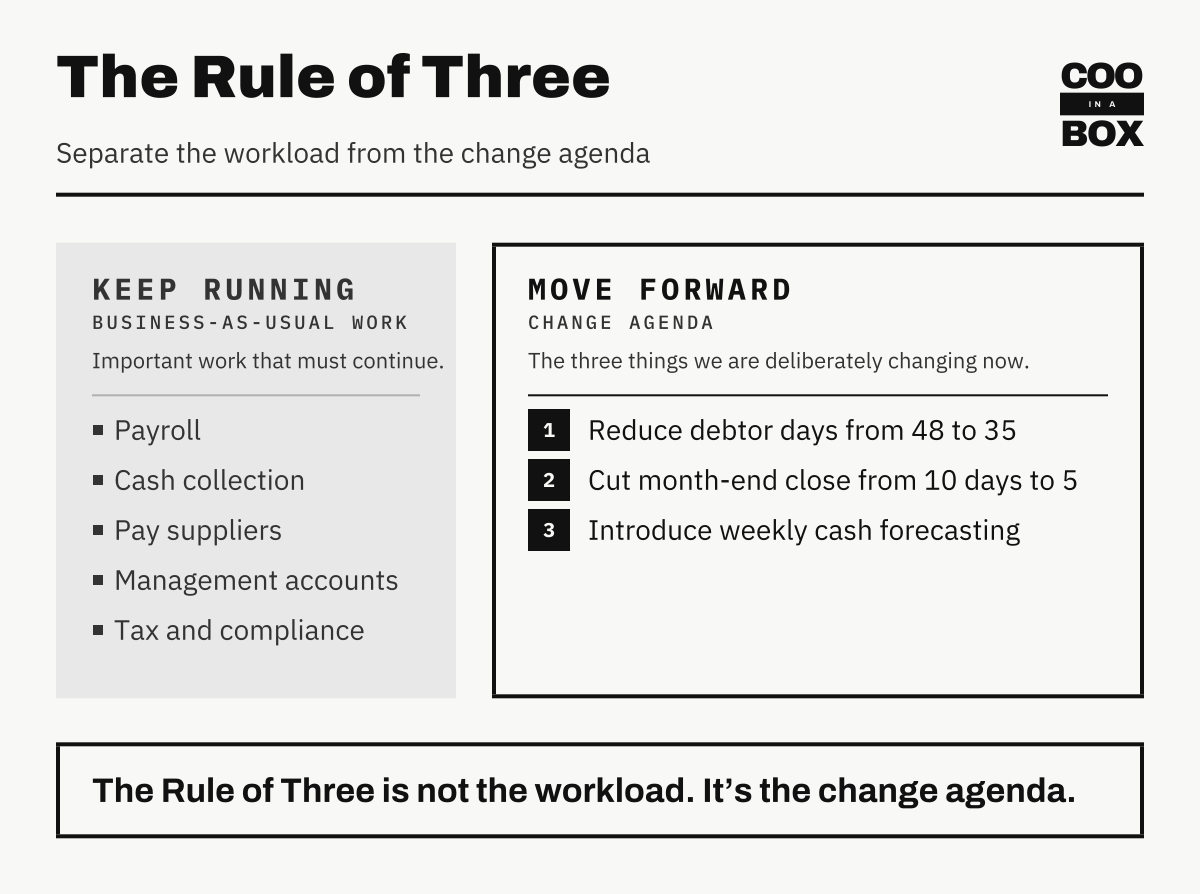
Separate KEEP RUNNING from MOVE FORWARD
This works in almost every function.
Operations still has customers to serve, suppliers to manage, problems to solve and people to organise.
Its three priorities might be:
Reduce average customer response time below four hours.
Remove the five biggest manual hand-offs.
Launch the new service model.
Compliance still needs to monitor the business, maintain policies and complete regulatory work.
Its priorities might be:
Automate the highest-volume monitoring activity.
Close the three largest recurring control gaps.
Redesign mandatory training.
The point isn’t to pretend there are only three things happening.
It’s to make the three things that should be meaningfully different in 90 days impossible to miss.
Three at every level
The model gets more useful when you cascade it.
COMPANY
What are the three outcomes that matter most to the whole business right now?
TEAM
What are the three things this team must change or deliver to support those outcomes?
INDIVIDUAL
What are the three contributions this person needs to make?
Not every priority has to map neatly one-to-one.
But there should be a visible line between them.
Company → Team → Individual
If the company says retention matters but nobody in Customer Success has a retention-related priority, something has broken in the chain.
If Operations is focused on reducing cost while the company is prioritising growth at almost any price, you have the same problem.
Priorities are useful partly because they tell people what to do.
They are even more useful because they expose when different parts of the business are quietly heading in different directions.
Try the five-person test
Ask five people in the business:
“What are the three most important things we’re trying to achieve right now?”
Don’t let them open a slide deck.
Don’t let them check the project plan.
Just ask.
If you get five completely different answers, you don’t have a communication problem.
You have a priority problem.
The priorities either aren’t clear enough, aren’t few enough or aren’t repeated enough to survive contact with the working week.
And if the leadership team can’t agree on the answer themselves, don’t expect the rest of the business to.
Use three as a forcing function
There is nothing scientifically magical about the number three.
That’s not the point.
Three is useful because it forces a choice.
Seven allows everything important to remain important.
Three creates a conversation about trade-offs.
So take the current priority list and ask:
Is this KEEP RUNNING or MOVE FORWARD?
If it’s MOVE FORWARD, is it genuinely one of the three most important changes right now?
If we add this, what comes off?
That third question does most of the work.
COMMON MISTAKE
Adding a fourth priority because it is “also important”.
Of course it is.
Most things that make the list are important.
The question is whether they are important now.
CHECK
Can everyone name the three priorities without looking them up?
DONE LOOKS LIKE THIS
The business still has plenty to do.
But everyone knows which three things must move.
The bottom line
A priority isn’t everything that matters.
It’s what you have chosen to move ahead of the other things that matter.
Keep running the business.
Keep meeting the obligations.
Keep doing the work.
But make the change agenda small enough that people can actually remember it.
What on your current priority list is actually just an obligation?
COO in a Box
Run a better business. One operating idea at a time.