

BOX 009 | 5 MIN READ | STRATEGY & EXECUTION
Ask a leadership team what their priorities are and you’ll usually get a sensible answer.
Grow revenue. Improve customer experience. Reduce costs. Build better systems. Develop the team.
All reasonable ambitions.
Then ask what they’re actually working on.
There’s a new CRM implementation. A website redesign. Three product improvements. A recruitment drive. A reporting overhaul. A customer retention project. An internal process review.
And that’s before you get to the day job.
Individually, most of these initiatives make sense.
Collectively, they might be the reason nothing is moving quickly enough.
The problem isn’t always prioritisation
Most businesses know how to prioritise.
They have quarterly objectives, project plans, leadership meetings and lists of what matters most.
But prioritisation only works if something genuinely loses.
Too often, a leadership team agrees on its top three priorities and then continues working on everything else anyway.
Nothing gets cancelled. Nothing gets taken off somebody’s plate. Nobody wants to abandon something they’ve already invested time or money in.
So the priorities change, but the workload doesn’t.
And the business ends up with a growing collection of commitments that nobody has the capacity to deliver properly.
You haven’t prioritised. You’ve just ranked an overcrowded list.
Every initiative has a hidden cost
The obvious cost of a project is the time and money required to deliver it.
The less obvious cost is everything it takes away from other work.
A new initiative needs meetings, decisions, updates, management attention and people from different teams.
Those people are usually already working on something else.
So every additional project creates another set of competing demands.
Decisions take longer because the same people are needed in five places.
Projects move forward in small increments because nobody has enough uninterrupted time.
And leadership meetings become exercises in reviewing progress rather than making progress.
The organisation is busy. People are working hard.
But the amount of work actually getting finished doesn’t reflect the effort going in.
Starting work creates activity. Finishing work creates value.
The difficult part is deciding what to stop
Adding something to a priority list is easy.
Removing something is much harder.
Every initiative has a reason for existing. Someone proposed it, someone approved it and someone has probably spent months working on it.
Stopping can feel like admitting a mistake.
But an initiative doesn’t have to be a bad idea to be the wrong use of your resources.
It might have made sense six months ago. It might still make sense next year.
That doesn’t mean it deserves attention today.
A useful question for any leadership team is:
If we weren’t already doing this, would we choose to start it today?
If the answer is no, the fact that you’ve already started isn’t a good enough reason to continue.
The Stop List
Here’s a simple exercise for your next leadership meeting.
Give it 15 minutes.
1. Write down everything that’s in flight
Not just the formal strategic projects.
Include the smaller improvements, internal initiatives and commitments that consume time but rarely appear on the main plan.
Look for the work that has quietly become permanent without anyone deciding it should.
2. Challenge what deserves to continue
For each item, ask:
Does this still support one of our most important outcomes?
What happens if we don’t do it for the next 90 days?
If we stopped, what capacity would we actually release?
Be specific about the third question. Stopping something that frees up no meaningful time or attention won’t solve much.
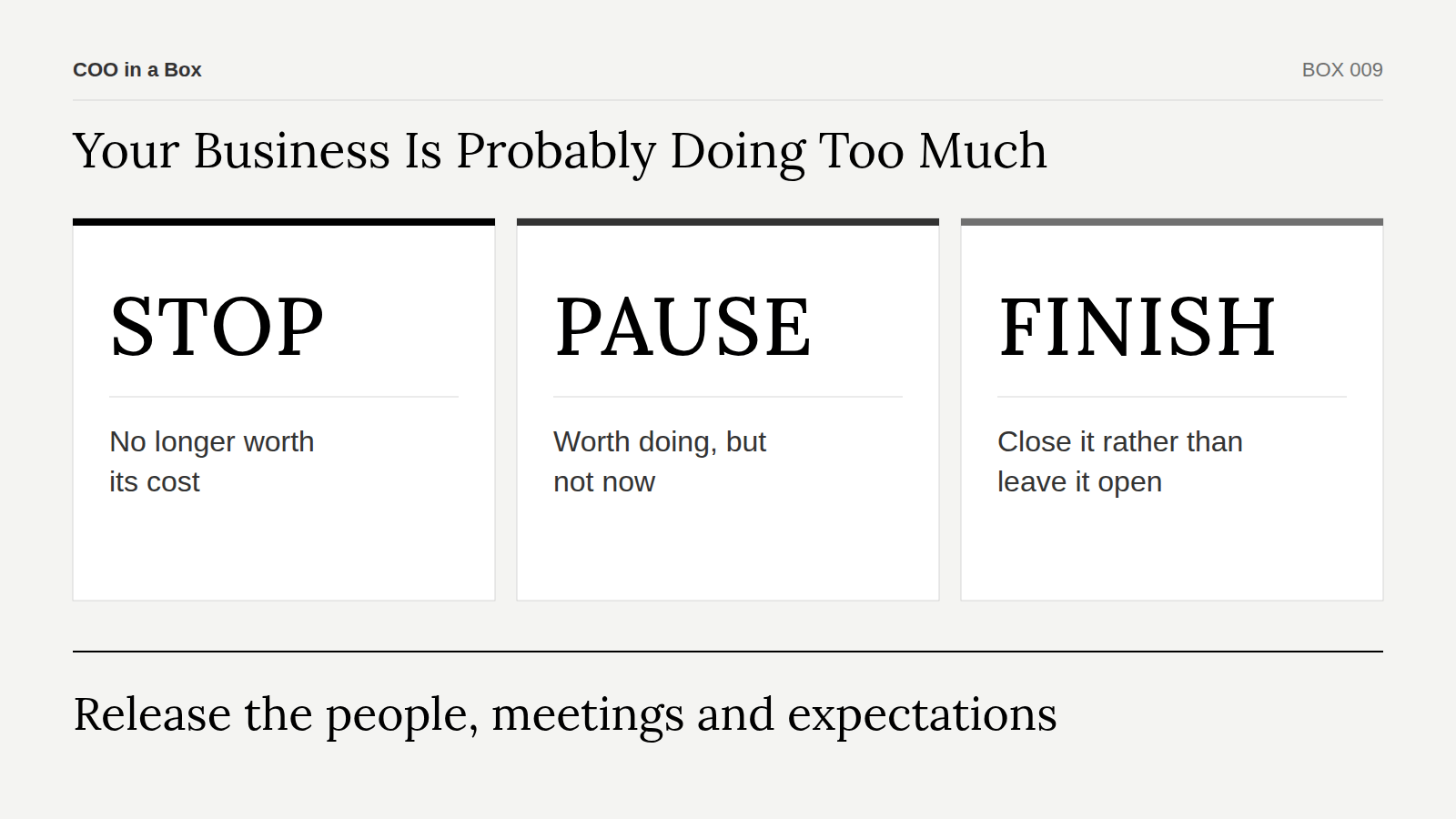
3. Stop, pause or finish
Choose three things that no longer deserve their current level of attention.
Stop work that no longer justifies its cost.
Pause work that matters, but not enough to compete with today’s priorities.
Finish work that’s nearly complete, rather than leaving another loose end behind.
Give each decision an owner, communicate it and remove the associated meetings, tasks and expectations.
Otherwise, you’ve just created another list.
The objective isn’t to stop three things for the sake of it.
It’s to create enough capacity to make meaningful progress on the things that remain.
Fewer things, finished properly
There’s a temptation in growing businesses to equate ambition with the number of things happening.
More projects. More initiatives. More plans.
But the businesses that execute well aren’t necessarily doing more.
They’re making deliberate decisions about where their limited time, money and attention will have the greatest impact.
And they’re prepared to leave perfectly good ideas on the table.
Because the alternative is a business where everything is important, everyone is stretched and progress feels permanently slower than it should.
Your strategy isn’t just what you choose to do. It’s what you’re prepared to stop doing.
PUT IT TO WORK
At your next leadership meeting, ask one question:
What are we currently doing that we wouldn’t choose to start today?
Find three answers.
Then do something about them.
COO in a Box. Practical ways to make growing businesses easier to run.
Subscribe for one useful idea every Tuesday.